

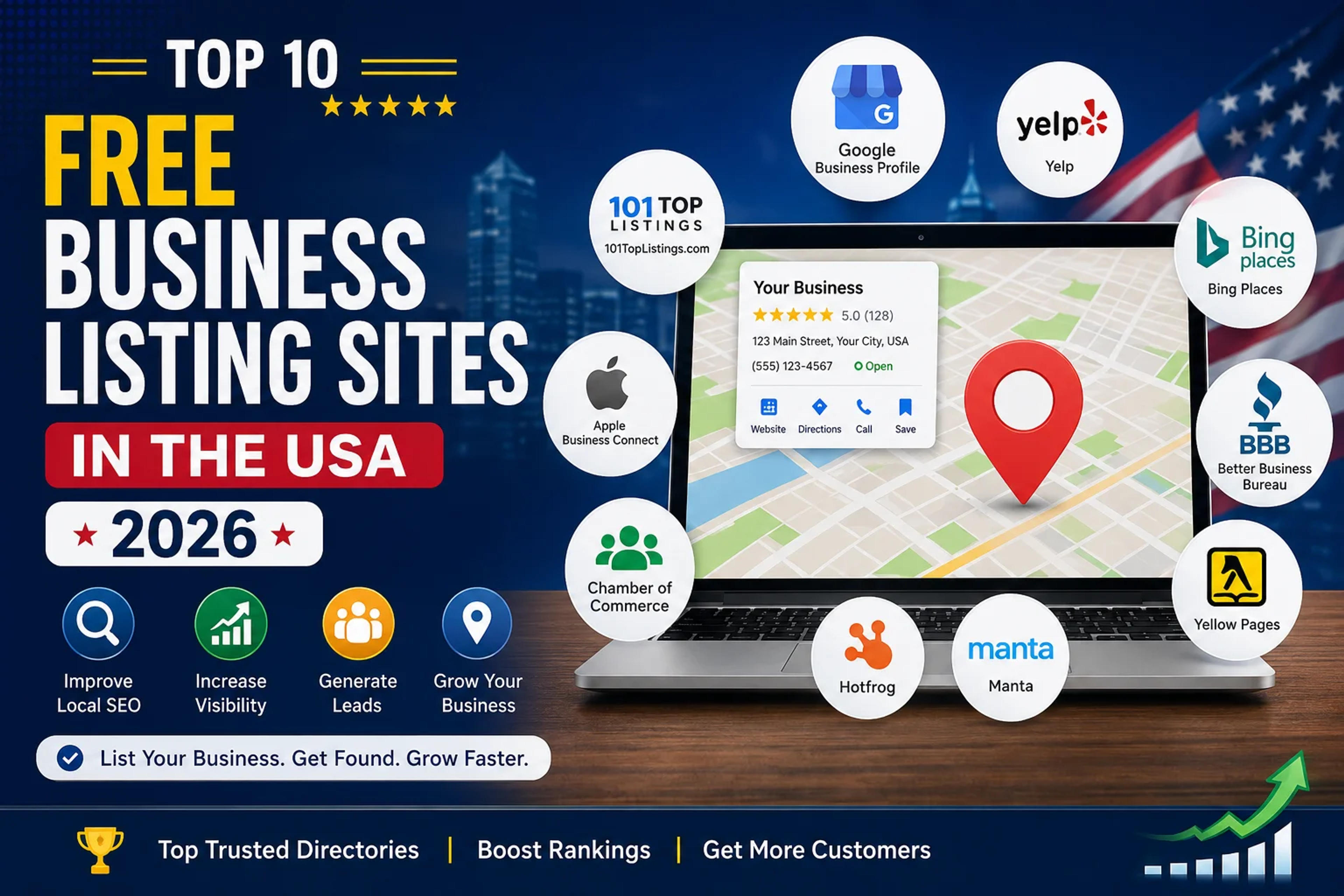
Free business listing in USA
Best Business Directory Websites for Small Businesses
Compare the best business directories for small businesses in 2026 from Google Business Profile to niche and global listing sites and learn how to choose the right ones.
Hassan YounasAugust 13, 2026 at 1:15 PMUpdated August 11, 20269 min read
Table of contents
If you've ever searched for a plumber, a dentist, or a marketing agency near you, there's a good chance a directory listing showed up before you even reached the company's own website. That's exactly why finding the best business directories to list your company on has become one of the simplest, lowest-cost ways for a small business to get discovered.
A strong directory listing does more than put your name on a page. It confirms to search engines that your business is real and active, keeps your contact details consistent across the web, and gives potential customers an easy way to find, compare, and trust you before they ever pick up the phone.
In this guide, we'll cover what actually makes a directory worth your time, the best business directory websites to prioritize in 2026, and how to get real results from every listing you create.
Why Business Directories Still Matter for Small Businesses
It's fair to ask whether directories still carry weight in an era of AI-powered search and voice assistants. They do arguably more than before, because search engines lean even harder on structured, verifiable business data to decide who to recommend.
Listing your business on the right directories can help you:
Improve local search rankings by reinforcing your Name, Address, and Phone number (NAP) across trusted sites
Earn referral traffic from people actively browsing directories to find a business like yours
Build credibility through reviews, ratings, and verified business profiles
Pick up quality backlinks that support your website's overall SEO
Appear in more places at once Google Maps, Bing, Apple Maps, niche directories, and beyond
Create a professional first impression before a customer ever visits your website
For small businesses without a big marketing budget, this is one of the highest-return activities available most of it costs nothing but time.
What Makes a Business Directory One of the "Best"?
Not every directory deserves your time. Before adding a new one to your list, it's worth checking it against a few criteria:
Trust and domain authority – Does the site rank well itself and get real traffic, or is it just a database of scraped listings?
Moderation quality – Are listings reviewed before they go live, or is it open to spam? A directory that vets submissions protects the value of every listing on it, including yours.
Category and industry relevance – Does it actually cover your type of business, or are you one of a handful of entries buried in an unrelated niche?
Regional and global reach – Some directories are built for a single country; others serve businesses across multiple regions and markets.
Free vs. paid access – Is there a genuinely useful free tier, or is the listing locked behind a paywall from day one?
Profile depth – Can you add a description, categories, photos, website link, and business hours, or just a name and phone number?
Directories that check most of these boxes are the ones worth your time in 2026.
The Best Business Directories for Small Businesses in 2026
1. Google Business Profile
Best for: Every local business, no exceptions.
Google Business Profile is the foundation of local SEO. It's what populates the map pack, the business panel, and the reviews customers see the moment they search your name or category. If you only do one thing from this list, claim and fully complete this profile.
2. 101 Top Listings
Best for: Small businesses, local service providers, startups, and agencies that want a clean, curated listing plus optional landing pages.
101 Top Listings is a growing directory built around one idea: quality over volume. Every listing is reviewed before it goes live, categories are organized by both industry and region — including North America, the Middle East, South Asia, and multiple parts of Europe — and businesses that want more than a basic profile can add a dedicated landing page for extra visibility. It's a strong option for businesses that want to be found without getting lost in a directory full of unreviewed spam.
3. Yelp
One of the most recognized review platforms in the U.S., particularly strong for restaurants, home services, and healthcare providers.
4. Better Business Bureau (BBB)
A trust-focused directory that helps established businesses signal credibility, though free access is more limited than on other platforms.
5. Bing Places
Microsoft's answer to Google Business Profile — free, quick to set up, and important for visibility in Bing Search and Maps.
6. Apple Business Connect
Essential if you want your business to show up correctly for Apple Maps and Siri searches on iPhone and iPad.
7. Yellow Pages
One of the oldest names in business listings. Brand recognition is high, though its SEO weight has faded compared to newer platforms.
8. Facebook Business Page
Not a traditional directory, but functionally one — many customers search Facebook directly to check hours, read reviews, and message a business before visiting.
9. Local Chamber of Commerce Directories
A smaller-scale but high-trust option. Membership often comes with a fee, but the credibility and local networking value can be worth it.
10. Industry-Specific Directories
General directories are useful, but a single listing on the right niche platform can outweigh several general ones. A law firm benefits more from Avvo or FindLaw than another generic directory; a medical practice sees more value from Healthgrades or Zocdoc; a contractor gains more from Houzz or HomeAdvisor. Identify the one or two niche directories that dominate your industry and prioritize them.
11. Trustpilot
A review-driven platform that carries significant weight for eCommerce and service businesses where customer trust drives conversions.
12. Crunchbase
Geared toward startups, agencies, and B2B companies — useful for visibility with investors, partners, and other businesses rather than local walk-in customers.
General vs. Niche Business Directories: Do You Need Both?
General directories like Google Business Profile, 101 Top Listings, and Yelp give you broad visibility across every type of search. Niche directories go narrower but often carry more weight within their specific industry a listing on a legal, medical, or home-services directory can influence a buying decision more than a generic profile ever will.
The best approach is rarely "one or the other." A well rounded small business typically holds a handful of strong general listings for broad visibility, plus one or two niche directories where its exact industry is searched directly.
Local, National, or Global Which Directories Should You Choose?
Most directory roundups assume every reader is a U.S. based business, but that's an increasingly narrow view. If you serve a single neighborhood, prioritize hyper-local directories and your Google Business Profile service area. If you operate nationally, directories like BBB and Yellow Pages carry more relevance. And if your business serves customers across borders or you simply want a broader footprint directories organized by region, such as 101 Top Listings' coverage across North America, Europe, the Middle East, and South Asia, help you get discovered in markets that U.S.-only directories simply don't reach.
Comparison Table
Directory | Free Listing | Reviews | Local SEO Value | Global Coverage |
|---|---|---|---|---|
Google Business Profile | Yes | Yes | ⭐⭐⭐⭐⭐ | Yes |
101 Top Listings | Yes | No | ⭐⭐⭐⭐ | Yes |
Yelp | Yes | Yes | ⭐⭐⭐⭐ | Limited |
BBB | Limited | Yes | ⭐⭐⭐⭐ | US/Canada |
Bing Places | Yes | Limited | ⭐⭐⭐⭐ | Yes |
Apple Business Connect | Yes | No | ⭐⭐⭐⭐ | Yes |
Yellow Pages | Yes | Limited | ⭐⭐⭐ | US-focused |
Facebook Business Page | Yes | Yes | ⭐⭐⭐ | Yes |
Chamber of Commerce | Varies | No | ⭐⭐⭐ | Local |
Niche/Industry Directories | Varies | Yes | ⭐⭐⭐⭐ | Varies |
Trustpilot | Yes | Yes | ⭐⭐⭐ | Yes |
Crunchbase | Yes | No | ⭐⭐⭐ | Yes |
How to Choose the Best Business Directory for Your Business
Run any directory through these questions before you invest time in it:
Is it free, or does the value justify the cost?
Is it relevant to your industry and location?
Are listings reviewed, or is it open to spam?
Can you add a description, photos, categories, and your website?
Does it support customer reviews or ratings?
Will it realistically send you referral traffic, not just a backlink?
If a directory checks most of these boxes, it earns a spot in your listing strategy.
Tips to Get the Most Out of Every Directory Listing
Creating a listing is only step one optimizing it is what actually moves the needle:
Keep your NAP identical everywhere. Even small inconsistencies (like "St." vs. "Street") can undercut local SEO.
Complete every field. Description, categories, hours, photos, and website an incomplete profile signals low effort to both customers and search engines.
Choose the most specific category available, not the closest general match.
Add photos. Listings with real photos consistently see higher engagement than text-only profiles.
Respond to reviews, positive and negative. It shows the business is active and attentive.
Revisit listings quarterly. Hours change, phone numbers change, and outdated listings quietly hurt trust.
Prioritize quality over quantity. Twenty accurate, well-maintained listings on relevant directories will outperform two hundred abandoned ones.
Frequently Asked Questions
What is the single best business directory for small businesses?
Google Business Profile is the most important starting point for almost every business, since it directly powers Google Maps and local search results. From there, layering in a few well-moderated general directories and one or two niche ones rounds out a strong presence.
Are business directories still worth it with AI-powered search on the rise?
Yes. AI search tools and voice assistants still pull heavily from structured, verified business data the same data directories provide. If anything, consistent, well-maintained listings are becoming more important as a trust signal, not less.
How many business directories should a small business be listed on?
There's no fixed number, but most businesses see the strongest results from a focused set of 15–20 relevant, high-quality directories rather than spreading thin across hundreds of low-value ones.
Do business directories actually help with backlinks and SEO?
Many do. A quality directory listing typically includes a link back to your website, and even "nofollow" links from trusted directories contribute to a natural, diverse backlink profile while reinforcing your business information across the web.
Is 101 Top Listings a good option for a small business just getting started?
Yes. It's free to create a listing, submissions are reviewed rather than published automatically, and businesses can browse or be found by both category and region which is particularly useful for businesses outside the U.S. looking for directories that actually cover their market.
Should I prioritize free or paid business directories?
Start with free, high-authority options most of the platforms that matter most (Google Business Profile, Bing Places, 101 Top Listings, Facebook) don't cost anything. Consider paid directories or premium listing tiers only once you've secured the free, high-value ones and want additional exposure in a specific niche.
Final Thoughts
The best business directories for a small business in 2026 aren't necessarily the biggest or the oldest they're the ones that are actively moderated, relevant to your industry and region, and easy to keep accurate over time. Start with Google Business Profile, add a handful of well-maintained general directories like 101 Top Listings, Yelp, and Bing Places, and round it out with one or two niche platforms built for your industry.
Ready to add your business? List your business on 101 Top Listings for free and get discovered by customers browsing by category and region.
#free business listing sites USA#free business listing sites USA#best business directories#business listing websites#local business directories
Written by
Hassan Younas
Related articles